Showing posts with label Comfort food. Show all posts

Monday, July 11, 2011

Saunfiana Gobhi Aloo (Cauliflower-Potato stir fry with aromatic fennel spices)


It's always interesting to see a slight difference in spice mix, the way you use them and at what stage you add them, makes a simple dish so elegant!

There is something very simple, nice and comforting about this cauliflower-potato preparation. I have always preferred to have cauliflower in its most natural form - less spice, crunchy, mild and flavorful. This perhaps comes from the way I have grown up eating this vegetable. Mom always kept it simple – either in a thin tangy tomato based gravy or as simple stir fry with lots of fresh cilantro and of course a few variations at times with  paneer, potatoes, peas or onions etc. 

This preparation is called 'Saunfiana' because of the use of  'Saunf' which means fennel seeds in Hindi. Fennel and coriander seeds always compliment the sweetness of cauliflower and potatoes.

Though this preparation has most of the spices very coarsely ground, as if in a very earthy/rustic style but the flavors you get as you bite into seem as if unfolding layers in a very elegant manner. With each morsel you bite into a different spice! 


I would rate this is as a must-make for vegetarian guests! By far, one of my most favorite cauliflower-potato preparation.  And it's super easy and fast!

You need (serves 2) :

Cauliflower – 1 cup (cut into bite size florets)
Potatoes – 2 (peeled and cut into half or quarter, to make it same size as the cauliflower florets)
Coriander seeds – 1 Tbsp
Saunf/ Fennel seeds – 2 tsp
Cumin Seeds – 1 tsp
Peppercorn – 10-15 nos. 
Salt – to taste
Mustard oil – 1-2 Tbsp
Asafoetida/ Hing – ¼ tsp
Red chili powder – ¼ tsp (adjust to taste)
Turmeric powder – ¼ tsp
Fresh cilantro/ Coriander leaves
Lime Juice – 1 tsp (optional or as per taste)
  1. In boiling water add half teaspoon of salt. Add the cauliflower and boil for 1 min. (Don't boil any longer longer as this will cook the cauliflower and make it gooey). Drain the cauliflower and run under cold water immediately. This is to stop the cooking process and retain the color/ texture. 
  2. Boil the potatoes till half done. Drain and keep aside. Again make sure they are only half cooked and not any more. This will makes sure the potatoes and cauliflower when cooked together will cook to perfection. 
  3. Dry roast on low flame the coriander, cumin, saunf/fennel seeds and peppercorn till you get a nice aroma. Don't over roast as they will burn and lose the flavor :).  Stop roasting once you get the aroma of the spices. Coarsely grind these spices in a mortar-pestle. Don't use a blender you need it very very coarse (as shown in the picture). If you don't have a mortar-pestle, take the spices in a zip-lock bag or roll between a cloth and bash it with any heavy object (no ceramic/ fine china please :))
  4. In a non-stick pan, add the mustard oil and heat till it fumes. This will ensure all the bitterness of the oil is gone. Add asafoetida/ hing. 
  5. Now add the potato, cauliflower and mix well. 
  6. Add red chili powder, salt and turmeric and give it a quick stir.
  7. Now cover and cook for 4-5 min.  
  8. Now add the ground spice mix and gently stir. 
  9. Cover and cook for another 4-5 min or until done. 
  10. Now add freshly chopped cilantro and a add a dash of lime (if you like it slight tangy)!
* if you are using baby potatoes, can leave the skin on.

Saturday, April 30, 2011

Rava Dosa - Restaurant style (South Indian Crispy Savory Crêpe)


Have you ever wondered how those Rava Dosas in restaurants have that beautiful net like texture. Well, I discovered that recently! I know, some of you may already know the trick, but coming from a North Indian family (where Idli, Dosas were the weekend highlights!) meant limited access to those secrets and tips. There was no Internet and google search my mom could depend on like we all do. She still keeps reminding me how lucky we are to have all this information at our finger tips, while in their times it was only friends, books, magazine and of course the Trial & Error method! :)


Still remember as a kid, mom painstakingly making dosa and idli from scratch. For Sunday breakfast, preparation would start from Friday! - The soaking, grinding and fermenting. I used to be so impatient to try some dosas, would pester mom to make at least an uttapam (soft savory pancakes with vegetables) soon after the batter was made. Mom would keep telling me to hold on till the batter ferments, but me-being-me, would not listen and get it my way. Oh, I can't stop writing stories and my life around food, can I!

OK so back to the recipe. This is super quick, super easy. Go ahead and treat yourself to some nice homemade, hot rava dosas – with texture and taste – restaurant style!

Just add onions to make an onion rava dosa, or stuff masala after it is ready to make a rava masala dosa! 

You need:

Maida/ All purpose flour - 1/2 Cup
Rice flour – 1 Cup
Rava/ Suji/ Semolina – 1 Cup
Ginger – 1 tsp (very fine chopped or grated)
Green chilies – 1tsp (very fine chopped)
Cumin – 1tsp
Crushed Pepper – 1 tsp
Salt – 1 tsp (adjust to taste)
Hing – ¼ tsp (I know a lot of you may not like hing, but it does make a difference here)
Fresh coriander/ Cilantro – handful (fine chopped, try using only the leaves, but that's OK! :) )
Dry grated coconut – 2 tsp (optional)
Buttermilk/ Curd – optional
Onion – 1 medium (finely chopped)
Ghee (clarified butter) or Oil – as much or less as you like. :)
  1. Mix all ingredients other than Ghee/Oil and Onions (last two from the list of ingredients above)
  2. Add water and make a very thin batter. Almost that of buttermilk consistency. Don't worry, rava dosa batter does in fact look like the buttermilk you get in south indian darshinis!
  3. Ok, now to making the dosa restaurant style, heat a nonstick tava/ griddle.
  4. Uniformly spread some chopped onions (depending how much you would like) on the tava. Skip if you don't like onions in your rava dosa.
  5. Hold the bowl containing the batter close to the griddle (this is to avoid messing your kitchen counter and stove top as the batter is too thin, but please keep safe distance!). Now scoop out the batter in the cup of your palms and sprinkle over hot griddle. Yes, just keep scooping and sprinkling till the entire tava is covered, and that is the only way you will get that nice net like texture. (If it is not a non stick pan , spray non-stick spray ,wipe clean and sprinkle the batter, but this would mean a lot of effort !).
  6. Cook on medium high flame. Don't add the oil/ ghee immediately and wait for a while for the dosa to cook a little. This trick makes  it nice golden brown and crispy! And remember, this dosa takes a little longer than regular dosas to get that golden brown color, so be patient. And don't worry about the dosas breaking, they will eventually hold very well once cooked.
  7. I have found a nice way to stop my dosas from falling apart. After spreading the dosa, I trickle some batter along the circumference as if joining the edges with dots. And this stopping the net texture from breaking when you are removing the dosas.
  8. Serve hot with pickle, or chutney. 
*Please mix the batter with a whisk. I know some of you may be too lazy to use a whisk but trust me it makes the whole process so risk free of those annoying lumps. Last thing you want to do in this quick recipe is searching for lumps and removing them! Use a whisk, in fact for any recipe that requires making a batter, it will save you a whole lot of unwanted effort. Stressing on this of course means I have been lazy before and learnt it the hard way :)
** You can use potato stuffing, the same one you use in masala dosa to make a nice rava masala dosas.  

Friday, April 29, 2011

Sabudana Khichri/ Upma (Sago/Tapioca Pearl Snack)


 A popular breakfast or snack that has a very nice balanced taste of sweet (sugar), salt, tang (lime juice) and heat (green chilies). As you bite into this crunchy yet moist savory dish, all these tastes unfold one by one.

There is one doubt I have always had - why is it called khichdi (gooey sticky porridge), and why not upma (dry granular porridge) because, both preparation and texture is more like upma. Never mind, it tastes good and that's what matters.

In different states of India, its prepared differently. In fact it is a very popular dish eaten during religious fasting. If you are making this for someone who is fasting, then skip the lime juice and replace salt with rock salt (sendha namak). As I write this I realise 'food for fasting' is a complete opposite of 'fast food'! Anyways, that topic for another day, now for the recipe!

You need:

Sabudana (Tapioca/Sago) – 1 Cup (when soaked plumps up to 1.5 – 2 times. So based on that you can decide how much you want to use, please follow soaking instructions to get best and foolproof results)

Powdered Roasted Peanuts – ½ Cup (You can adjust this to your liking, but it tastes good with lots since it makes it crunchy, don't make a very fine paste, make a crumbly kind of powder)
Whole roasted peanuts – 8-10 nos.
Lime juice – 1.5-2 Tbsp (you can adjust this to taste, traditionally its high on tang)

Sugar – 1-1.5 tsp (you can adjust this to taste, traditionally its has enough sugar to balance the tang from the lime juice and heat from the chili)

Oil – 1 Tbsp (typically 2 Tbsp would be used but I tend to go a little shy on this)
Ghee – 1 tsp (optional but does make a big difference)
Cumin Seeds – 1/4 tsp
Salt – to taste

Green Chillies – 3 nos (finely chopped, adjust to taste, though traditionally its made pretty hot)
Potato – 1 medium (boiled peeled and cut into small cubes)
Fresh shredded coconut – 1/3 Cup
Fresh green coriander/ Cilantro – handful (needs generous helping and use only the leaves)
Black pepper powder – ¼ tsp (optional, check my notes in the bottom to read why)
  1. Wash sabudana for 10-15 sec. Soak it in water completely immersed for 30 min. After 30 min, drain out all the water. Cover the bowl and let it rest for 6-7 hours. Make sure you keep it covered at all times, else the sabudana will dry out and get chewy while cooking. If possible gently mix the sabudana with a fork without damaging them every 1-2 hours. This is not mandatory but keeps the sabudana moist uniformly.
  2. Once the sabudana is all plumped up, mix salt, sugar, lime juice and powdered peanuts. Remember you can always go a little conservative with sugar and lime juice at this stage and add later if you feel the need. These measurements are adjusted as per my taste.
  3. In a nonstick pan, heat oil and ghee. You can always add ghee instead of oil for better taste. But I have mixed the two to cut down on ghee and still have that fragrance.
  4. Add cumin seeds. Once they splutter add green chilies. Fry for a min.
  5. Add sabudana mixture to the pan. Mix well. Reduce flame to low, cover and cook for 1-2 minutes.
  6. Add shredded coconut and the potatoes. Fry for another min. Mix gently as the the sabudana can break easily. Adjust salt, lime and sugar at this stage.
  7. Cover and cook till the sabudana is cooked through. The best way to judge if its cooked well is when all the sabudana beads become translucent and none of them remain opaque white. This process may take anywhere between 7-10 min depending on how much moisture they had while soaking. Remember, cover and cook but stir intermittently so that it doesn't stick to the bottom and burn. You can always sprinkle very little water in between to add a little moisture to cook. But just sprinkle else they will get sticky and gooey. Last this you want is to chew gum after all that effort! :)
  8. Add whole peanuts. I add them in the end as I prefer them crunchy and not the soft steamed feel they get, while cooking with lid on. Mix them 
  9. Add coriander leaves and serve hot.
*There might be many ways to soak the sabudana, but this has been a fool-proof method for me. It gives perfect moisture to sabudana without making it too soft or gooey.
**Are you are wondering if it makes sense to buy one full packet of sabudana (the Indian store here sells nothing less than a 2 lb pack, smart!!) just for this one odd khichdi? Well good news, I will soon be posting recipes for yummy sabudana kheer, sabudana vada and a few more recipes that call for sabudana. So go ahead and pick that sabudana packet this time!
*** The starchiness of tapioca is complimented by pepper. Try adding a pinch to a small portion. And if you like the taste, go ahead add to all. I like mine with a hint of pepper.  

Wednesday, April 27, 2011

Lahori Chana Dal


One of my friend's who has her origins from Lahore (Pakistan) gave me this recipe. There is something very nice about the tangy taste you get in this kind of preparation. The chana dal doesn't get gooey, retains its texture and taste. When you are looking for a dal dish, that is not rich (dal makhni, ma-ki-dal etc.) and yet tastes different, go for this variation. I won't promise a whole new taste that you would have never imagined, but give it a try, its refreshing . Awesome with Paratha (flaky Indian bread) on one of those days when you want to eat simple but delicious comfort food. 

You need:
(Serves 2)

Chana Dal/ Bengal Gram – ½ Cup (soaked in water for 30 min)
Coriander powder – ¾ tsp
Turmeric powder – 1/3 tsp
Red chili powder – ½ tsp
Yellow onion – ½ medium size (I have never made with red ones since I was told to make with yellow)
Garlic – 2-3 cloves
Ginger – ½ inch
Tomato – 1 (medium to large)
Cumin seeds – ½ tsp 
Green chilies – 2-3
Salt 
Fresh coriander leaves/ Cilantro – Handful
Lemon juice – ½ Tbsp (adjust to your taste)
  1. In a pressure cooker add chana dal, 1 cup of water and ½ tsp salt. On high flame, cook till 3 whistles. Let the pressure ease on its own. You want dal that is cooked but not too soft and gooey. (this works for my pressure cooker, you may want to check for yours) 
  2. In a blender make fine paste of onion, ginger, garlic, tomato and 1 green chili. Add ¼ cup of water if required.
  3. In a heavy bottom pan, without adding any oil cook this paste. 
  4. Once the water content reduces to half add turmeric, coriander powder, red chili powder and salt to taste. Cook till all the water evaporates and the masala starts sticking to the base slightly. 
  5. Now add oil and cook well. The oil should start separating from the masala. Usually takes 3-4 min on medium high heat.
  6. Tip in chana dal and cumin seeds. Let it cook for 2-3 min. 
  7. Now add the remaining 2 green chilies and lemon juice. Cook for a min or two.
  8. In a separate pan, in minimum oil fry ginger juliennes. Add to the dal. Remove from heat.
  9. Garnish with fresh cilantro and serve with hot parathas.

Friday, April 01, 2011

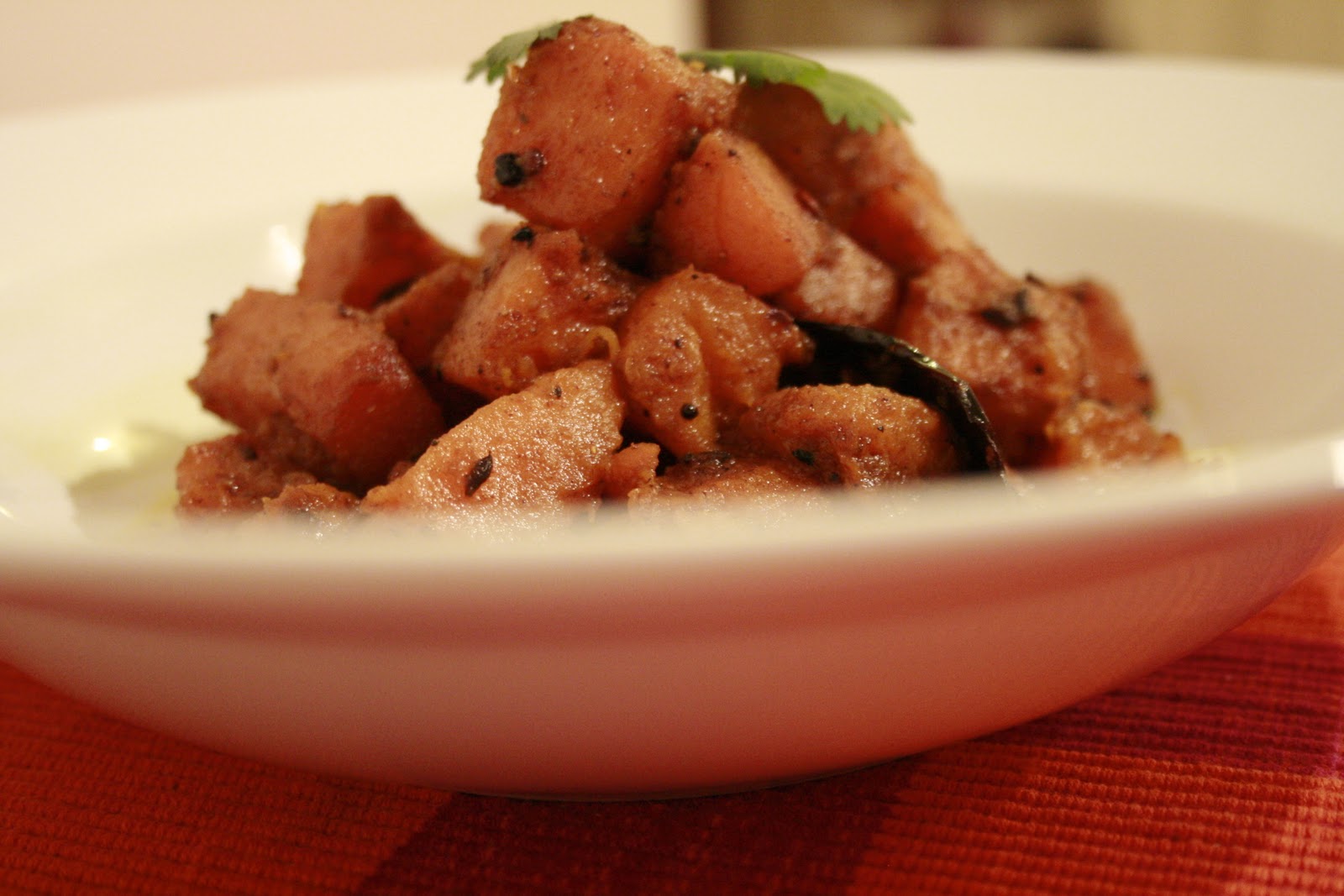
Kaddu / Pumpkin/ Butternut Squash


Takes me back to my childhood. While most kids dislike the word veggies, let alone something like pumpkin, I used to gorge on raw veggies as a kid. And now when I think about it, wonder what made me eat raw okra, beans, and whatever that was cooking for dinner, RAW!!

Anyways, back to Kaddu. I love this simple, no fuss, preparation. The sweet and tangy taste goes so well with poori (deep fried flat bread) or plain simple steamed rice. 

You need:

Pumpkin/ Butternut – 500 grams (peeled and cut into 1 inch cubes)
Panch Phoran – 1 Tbsp
Whole red chili – 2-3 nos
Coriander Powder – 1 tsp
Garam Masala – 1 tsp
Turmeric – 1 tsp
Sugar – 1 tsp
Amchoor/ Mango powder – 1 tsp (adjust to taste)
Salt
Oil
  1. Heat oil in a pan, add panch phoran. Once it crackles, add hing and whole red chili. 
  2. Add turmeric and coriander powder. Let it cook for a min on a very low flame in the oil.
  3. Add the pumpkin, salt  and give it a stir for a min. Add garam masala and mix well. 
  4. Cover and cook. Intermittently stir. Add very little water if its starts drying up.
  5. Once the pumpkin is cooked, add the sugar and aamchoor to taste. Serve hot.
* Half butternut squash may seem a lot, but since it shrinks a lot when cooked, serves 2. 
**Panch Phoran (Five spice mix). If you don't have the ready-mix, you can mix the following in equal quantity (i put lesser fenugreek since its quite bitter) 
- Saunf/Fennel seeds
- Methi/ Fenugreek seeds
- Rayi/Mustard seeds
- Kalaunji/ Nigella seeds
- Jeera/ Cumin seeds

Thursday, March 24, 2011

Mustard flavored broad beans (sem)


This recipe comes from my mom's kitchen and was probably handed down to her from my grandma. And nothing much seems to have changed over the years, be it the recipe or ingredients. Though spice grinders have replaced a quintessential element of kitchens in those days - the mortar pestle; and pre-cut  veggies (available round the year) have replaced seasonal veggies from your own farm, one thing remains constant – the taste. Broad beans (sem, pronounced as 'same') and potato coated in mustard paste, with hot steamed rice is what makes me feel so much at home, cozy and comfortable. 


You need:

Broad beans / sem (pronounced as 'same')/ Simba – 200 grams
Potato – 1 medium size (peeled and cut into quarters)
Tomato – 1 medium size (cut into quarters)
Mustard seeds – 1.5 tbsp (soaked in water for 30 min)
Ginger – ½ inch
Garlic – 2 cloves
Green chili – 1 or 2 
Mustard oil – 1 tsp
Fenugreek seeds – ¼ tsp
Coriander powder – 1 tsp
Turmeric powder – ½ tsp
Dried mango powder/ Aamchoor – ½ tsp

  1. Blend together mustard seeds, ginger, garlic and green chili to a smooth paste. 
  2. Heat oil, add fenugreek seeds. 
  3. Add potato and fry on high flame for a minute. 
  4. Add about 1 tbsp of blended paste (mustard, ginger, garlic and green chili), coriander powder, turmeric, and dried mango powder.  Fry for another min.
  5. Add the beans and tomato cut into quarters. Cover and cook till done.
  6. Serve with hot steamed rice.

Thursday, March 17, 2011

Matar/ Green peas Paratha (Indian bread stuffed with sweet green peas)


You need:

Wheat flour
Green peas - 500 grams (I use organic/ frozen baby sweet green peas)
Garlic - 5-6 cloves (finely grated)
Onion - 1/2 medium size (finely chopped)
Green chili - 2 (finely chopped)
Cumin seeds - 1/2 tsp
Coriander powder - 1tsp
Chili powder - 1/2 tsp
Turmeric powder - 1/2 tsp
Salt
Garam Masala - Pinch


1) Heat a Tbsp of oil, add cumin seeds. Once it crackles, add the green chilies, garlic. Fry for a minute.

2) Now add onion, salt, turmeric. Once the onions get translucent, add coriander powder and red chili powder. Fry for a min

3) Now add the peas with 3 tbsp of water. Cover and cook till peas become totally mushy. You can also use a hand blender to make it into a coarse paste. But make sure some peas are still seen.

4) Now make dough using wheat flour and water.

5) Roll out the wheat flour balls to make a circle, keep one table spoon of the stuffing in the centre and fold from all sides to close and make a ball. Roll out the ball gently to make a round paratha.

6) On a got griddle, shallow fry with one tea spoon of oil (or cooking spray) till golden in colour.

7) Serve hot with some butter, yogurt and mint chutney.


* You can also use all purpose flour/ maida
** Deep frying a slightly smaller and thicker stuffed bread will make it a kachori.
*** Aloo dum goes well with this dish

Monday, March 14, 2011

Dalma memory lane


I have loved and craved for Dalma since , let me remember... yes.. probably since I was old enough to metabolize semi-solid food. Oriyas probably have this before they start having milk powder!

Lets see the starting line-up: The usual suspect "panch phutan" (This is what makes Oriya cuisine 5-star!) this time comes flavored with roasted jeera (cumin) and the oh-so-wonderful smell of ghee (clarified butter). It's the way I like my food - full of flavor, aroma to die for, yet balanced with nutrition and light on the stomach. (There are, of course, those times of sheer abandon when nothing can beat a deep fried pakoda - but hey, kids may be watching this blog!)

The trio of ghee, roasted cumin and panch phutan gets an added dimension with fresh ginger used in the tempering (tadka in hindi) process. All this flavors a prdemoniantly tuberous/fibrous mixture of vegetables (potato, sweet potato, raw banana, raw papaya, pumpkin, eggplant and tomato) and daal (toor / arhar). Not all types of vegetables go well here - the mantra is to stay close to the tuberous and fibrous formula. I have seen variations that include radish, exclude tomato, include slices onions! - So go on - try your own improvisation.

Just a warning - Common veggies that just dont go with dalma are okra, beans, cabbage and cauliflower. I have never tried carrots either.

You need:
1 cup toor/arhar daal

Bite-size chunks of:
1/2 cup pumpkin
1/2 cup raw papaya
1 mid-sized potato
1 cup eggplat
1 large tomato
..and
1 tbsp grated ginger
1 bay leaf
Few peppercorns

For tempering
1 tsp ghee
1 tbsp ginger
pinch of asafoetida
1/2 tsp turmeric powder
Couple of dried red chilis
1 tsp panch phutan

For garnish
1 tsp roasted and ground cumin

and Salt to taste!

Start by soaking the daal for 40-45 mins. I usually soak it well, since I like my dalma gooey! In the meantime, chop all your veggies, ginger and roast the cumin and grind it (if you have a spice grinder, this can be real quick! I usually roast my cumin once in a while and store them away in the spice box).

Put the lentils, veggies, ginger with bay leaf in the pressure cooker, add 2 cups of water and cook on medium heat for around 15-20 mins (or 2-3 whistles)

For tempering, heat the ghee in a pan and add the asafoetida, panch phutan, red chilis, ginger. Once they start crackling, add them into your pressure cooker to the veggie mix

Garnish with roasted ground cumin.

Eat with steamed rice, or plain rotis! I like to squeeze lime and add ghee into my rice when I have dalma. If you do the same, that makes two of us!! Remember - the only thing better than getting to eat dalma, is to be able to make it yourself, so you can have the flavors of your childhood - in your home, anywhere you are!

Go on, get nostalgic!

Thursday, March 10, 2011

Aloo Rasa/ Potato in tomato based curry (Station wali subzi)

This recipe goes a long way back into my childhood. My memories of this tangy, juicy, and spicy potato-tomato gravy have strong association with railway stations. As a child, I remember traveling with my parents in train during summer vacations. I used to look forward to two important things, whenever the train stopped at any big junction/ station. First one being comic books and second was the potato curry which was served with maida pooris/ loochi (deep fried indian flat bread made from all purpose flour). Even now, I refer to it as 'station-wali-subzi' . 


Everytime I return home after an extended stay away from mom, I ask her what she plans to make for us. And one of the things that she won't  miss for anything would be the 'station wali subzi'. So for me, there couldn't be anything more comforting! :)


You need:

Potato - 3-4
Onion - 1 Medium size (finely chopped)
Ginger - 1 inch (finely chopped)
Garlic - 3-4 cloves (finely chopped)
Tomato - 1 medium size (finely chopped)
Red chili powder- 1/4 tsp
Turmeric - 1/4 tsp
Coriander powder - 1.5 tsp
Garam masala- 1tsp
Cinnamon stick - 1 inch  ( adjust based on the variety of cinnamon  you have)
Bay leaf- 2
Cumin seeds - 1/2 tsp
Green cardamom - 4-5
Coriander leaves/ Cilantro - Lots
Oil (I prefer mustard oil but any other veg oil will also do)

1) Boil Potatoes
2) In a pressure cooker heat oil. Add cumin seeds, bay leaf, cinnamon stick, cardamom pods.

3) Add ginger, garlic. Once you get their aroma add the onions. Add salt and turmeric and fry till they become translucent/ leave oil on the side.

4) Add coriander powder, red chili powder and fry for 1-2 min.

5) Add tomatoes and fry till they become a little mushy. At this stage add garam masala and fry well.

6) Roughly mash the boiled potatoes so that you have some big chunks and some smaller. Close the lid and give pressure till one whistle (on medium heat)

7) Add loads of green coriander leaves/ Cilanro when the gravy is hot (as soon as you open the lid)

Wednesday, March 09, 2011

Kundru in poppy seed


You need:

Kundru/ Tindora - 300 grams
Oil
Cumin powder - 1tsp
Coriander powder - 1tsp
Red chili powder - 1tsp
Dry mango powder (aam choor) - 1 tsp
Turmeric - 1/2 tsp
Nigella seeds/ Kalonji/ Onion seeds - 1/2 tsp
Dry red chili - 2-3
Poppy seed paste - 3 Tbsp
Salt


1) Slit the Kundru or Tindora vertically in 4 long slices in such a way that one end stays intact and holds the 4 cut slices (like the stem of a flower).

2) In a bowl toss kundru with little oil, cumin powder, coriander powder, red chili powder, dry mango powder (aam choor), little turmeric and salt.

3) Heat oil in a pan and temper the oil with nigella seeds/ kalonji/ onion seeds and dry red chili.

4) Add the kundru and stir so that the all the spices get coated. Saute them on high flame for 3-4 min(skin looks a little crispy and looks light brownish in color). Turn heat to medium high, cover and cook till 3/4 done.

5) Add poppy seed paste and mix well. Add a little water if required and cook till the kundru is cooked and the water has dried up. Garnish with cilantro leaves.

*Soak poppy seeds in water for 15-20 min. Blend in a spice grinder for a nice smooth paste.
**You can use poppy seed powder too, but it doesn't taste as good.

Mango Dal


As a child i was never a big dal fan and my mom says that feeding me dal was a big challenge. However over a period of time, I have starting loving this protein rich healthy dish :) The tangy taste of this preparation goes really well with the sweetness of steamed rice.

You need:
Toor dal - 1 Cup
Raw mango - 1 No. or as per your taste(peeled & cut length wise-1 inch thick)
Green Chili - 1-2
Fresh coconut- 4-5 Tbsp
Red chili powder - As per your taste


Mustard seeds - 1 tsp
A sprig of curry leaves
Whole dry red chilies - 2-3
Ginger - 1 inch piece cut into juliennes
Salt as per taste
Sugar - 1 tsp
Oil

1) Cook toor dal with a pinch of turmeric & pressure cook until soft, yet retaining their shape.

2) In a blender, coarsely grind coconut and green chili.

3) Heat oil in a heavy bottom pan, crackle 1/2 tsp mustard seeds. Add curry leaves, red chillies, coconut + green chili mix and fry for a min. Now add the mango slices & cook until soft (but make sure the mango slices retain their shape).

3) To this, add cooked dal, add enough water to get the right consistency. Adjust salt & sugar. Bring the mixture to a boil.

4) Heat 1 tsp of oil, crackle the remaining 1/2 tsp mustard seeds, add a few curry leaves, ginger juliennes. Switch off the heat, add red chili powder and immediately add it to the dal. Garnish with cilantro/ hara dhaniya.